


Listening effort
This page introduces the concept of listening effort, an important topic that has received growing attention in recent years. For more detailed information, please see the Japanese version (https://cdc.lab.ibaraki.ac.jp/hearing/listening-effort), which can be read using online translation tools.
1. What is Listening Effort
Listening effort (LE) is like the mental effort we put into better understanding speech, especially when things get tricky. LE is defined in an academic context: “the deliberate allocation of mental resources to overcome obstacles in goal pursuit when carrying out a [listening] task”(Pichora-Fuller et al., 2016).
It involves more than just hearing—our brains work hard to piece together what we might miss, even if our ears catch most of it (Tabaru et al., 2021). People with normal hearing often put in more effort in noisy environments. However, those with hearing challenges might find themselves constantly working hard without even realizing it, since the sounds they receive can be unclear.
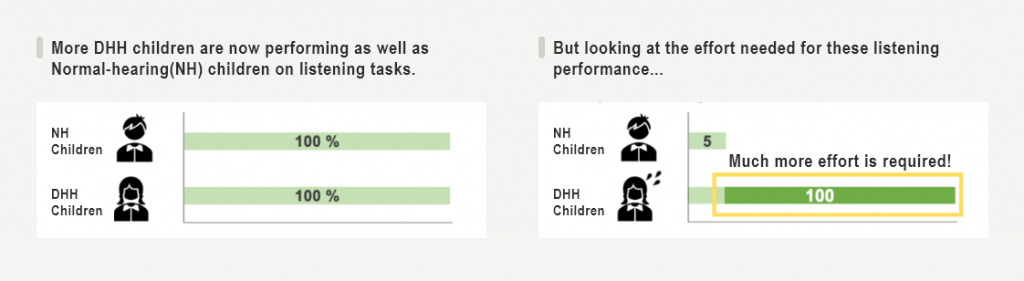
Instead of asking only whether someone can hear and understand the sounds well, we can also consider how much effort it takes to understand them. Sometimes, understanding can be really tough even when the sounds are audible, and the effort required can vary by person (Koelewijn et al., 2018). Viewing listening challenges from this angle might help us find better ways to support those who need it most.
2. Factors affecting listening effort
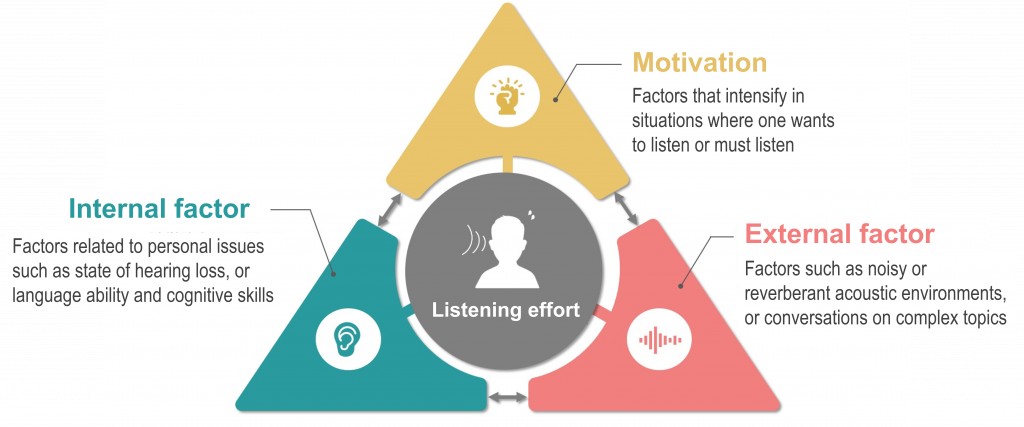
Even in the same environment, each person’s LE can be different. There are three key factors to consider. First, personal factors like the degree of hearing loss and language skills. Second, environmental factors such as noise levels and the difficulty of the conversation on a complex topic. Lastly, motivation plays a big role.
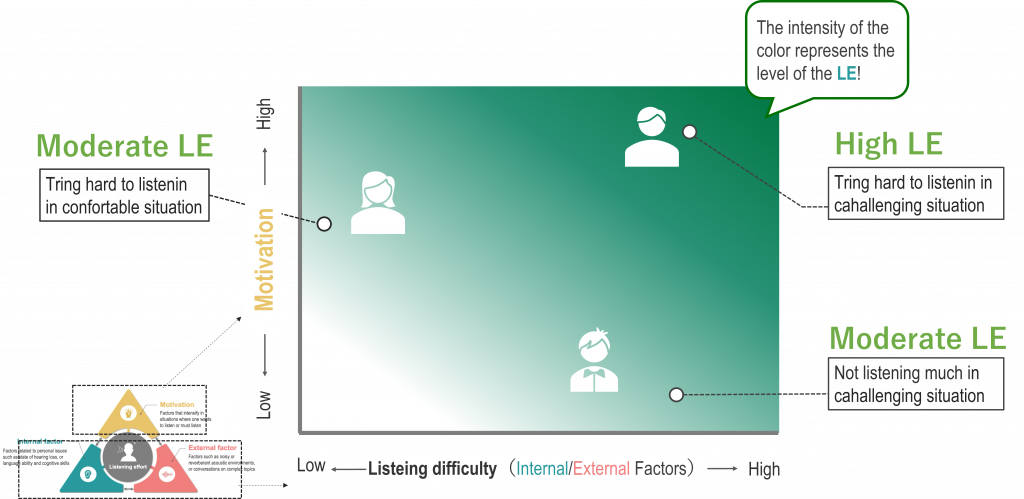
When exploring how listening difficulty and motivation relate, it becomes clear that trying hard to comprehend something difficult often leads to increased effort. But when motivation is low, that effort doesn’t grow as much. On the other hand, if the information is really important, effort tends to increase even when understanding is easy. This shows that effort can often be influenced by our own will, which is a really helpful insight for providing support.
3. Problems related to listening effort
The issues of Listening Fatigue and Listening Battery
When it comes to LE, we talk about ‘Listening Fatigue (LF)’ and ‘Listening Battery (LB).’ LE happens while we’re actively listening. Meanwhile, fatigue and battery depletion refer to the feelings of tiredness and the energy expended during LE.
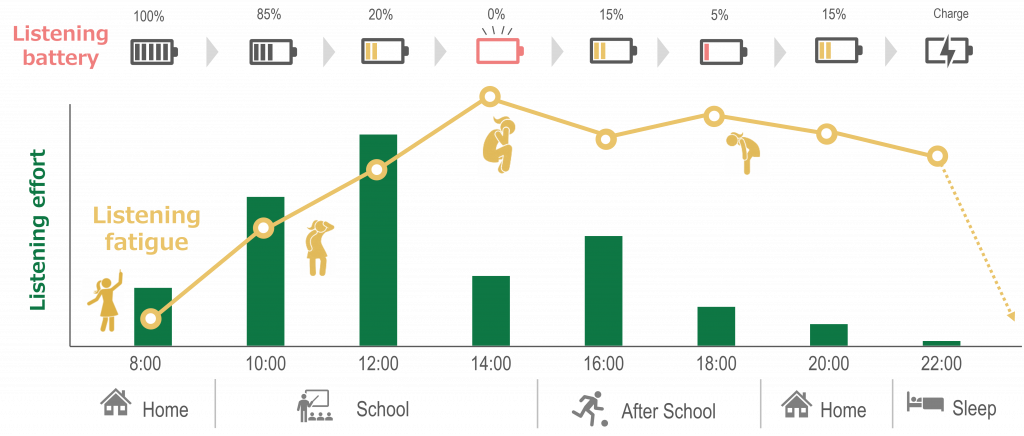
Even if someone can understand what’s being said, there may be invisible burdens on the listener. A simple model of an elementary school student’s day illustrates how LF builds up throughout the morning (or as LB runs down), leading to a sharp drop in LE around 2 o’clock. This isn’t because they aren’t paying attention or concentrating, but because their energy has been drained.
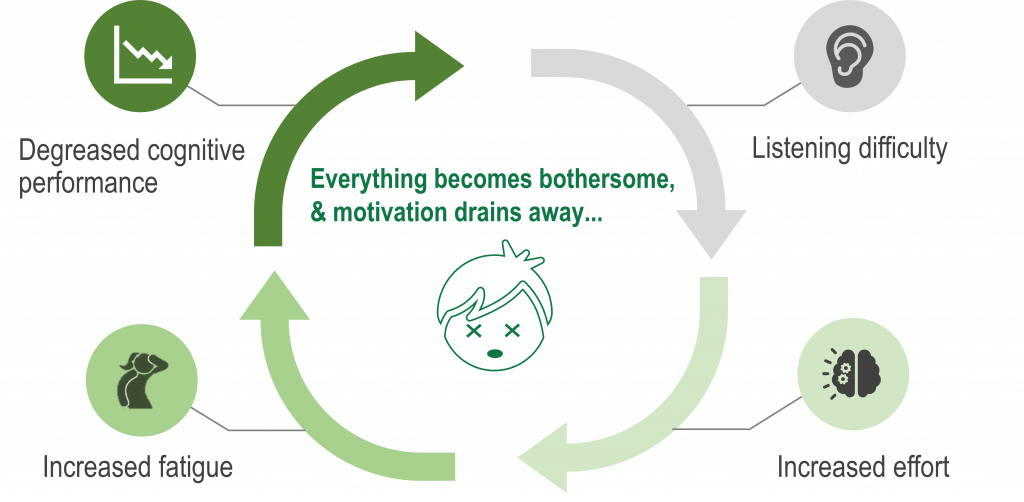
Bess et al.’s (2014) model depicts a cycle in which difficulty with listening and understanding leads to more LE, which then leads to LF. This fatigue worsens listening performance, making understanding even harder. For children, this might mean doing poorly in school and not wanting to go, while for adults, it might lead to less social activity. Essentially, when listening requires a lot of effort for a long time, it can slowly affect everyday life and overall health—mental and physical—without the person even realizing it.
The impact of listening effort on cognitive aspects
When we picture the ‘processing resources’ in the brain as a square, it’s helpful to know that if listening isn’t too hard, roughly half of these resources can go toward understanding. The rest can support deep comprehension, memory, and the preparation of responses. But when listening gets tougher, more LE is needed, leaving less capacity for memory and deep understanding.
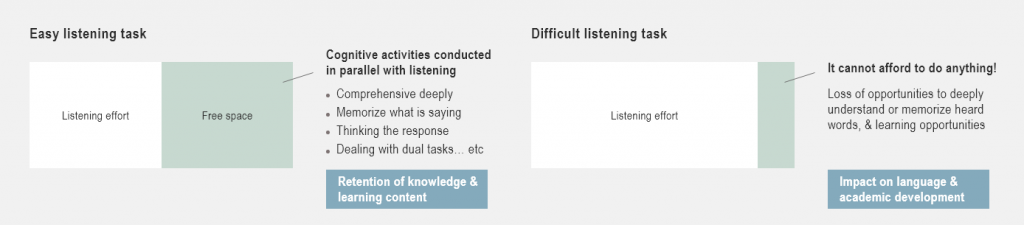
Especially for children, when they don’t get enough chances for deep understanding and learning, it can add up over time. This may lead to long-term language development challenges and struggles in school (Tabaru, 2023). That’s why it’s so important to find ways to make listening easier, even if they can listen and understand at that moment. Helping with this also boosts their comprehension skills and overall learning growth.
4. Assessment of Listening Effort
Various methods are being explored to assess LE (see Shields et al., 2023 for details). While many of these are still in the early research stages, only a few assessment tools are readily applicable in clinical practice or real-world settings. Besides the importance of ease of use in practical contexts, it’s also vital to consider that effort can be affected by an individual’s motivation and intentions. Therefore, subjective indicators of effort and fatigue might be particularly valuable at this moment. These include simply asking individuals right after listening tasks how hard they worked or how tired they felt, as well as tools like the Vanderbilt Fatigue Scale (VFS), which measures LF.
However, when it comes to subjective methods, it’s helpful to remember that each person’s perception can differ significantly. For children, there might be additional challenges, like not fully understanding themselves or accurately assessing their feelings. Keeping these factors in mind, it’s crucial to carry out assessments carefully designed to meet their specific needs and purposes.
5. Supporting Listening Effort
Basic Concept of Support
The key phrase to focus on is ‘listening comfortably even when we can hear well.’ We’re looking at support for ‘people who experience difficulty even when they can hear well,’ and it’s really helpful to look at hearing issues from different perspectives alongside the individual. When providing support, we mainly aim for two things: 1) making information more accessible, and 2) wisely including rest as part of the process.
Improve information accessibility
Hearing devices: properly adjusted hearing aids are often the best choice for clarity. For example, Oticon’s research brief examines whether new hearing-aid innovations can also make listening easier (Zapata-Rodríguez & Santurette, 2024). For those already wearing hearing aids or cochlear implants, they might find hearing assistance systems helpful. These devices help deliver the speaker’s voice more directly, reducing the impact of distance and background noise, and making conversations more comfortable.
Information support: Note-taking, text interpretation, and using sign language can all help lighten the load, even for those who can hear well. It’s great to be flexible and choose whether to focus more on auditory or visual information depending on the situation.
Environmental adjustments: Ideas like reducing noise and thoughtfully arranging seating can really improve the environment. For children, it’s great when adults around them offer support and cheer them on to advocate for themselves. For more helpful insights, please check out Kataoka and Nakagawa (2021) in ‘Important things in school life for elementary, junior high, and high school students with hearing loss.’
Support for facing listening effort
Putting in a lot of effort is definitely admirable. It’s great to see the willingness to try hard—it deserves respect. It’s also helpful to think about how that effort is divided. Of course, in important meetings or when individuals are eager to listen to a specific topic, putting in extra LE is natural. But in situations that aren’t as critical, we might consider using support tools or concentrating on sharing information, which can make things easier and more comfortable.
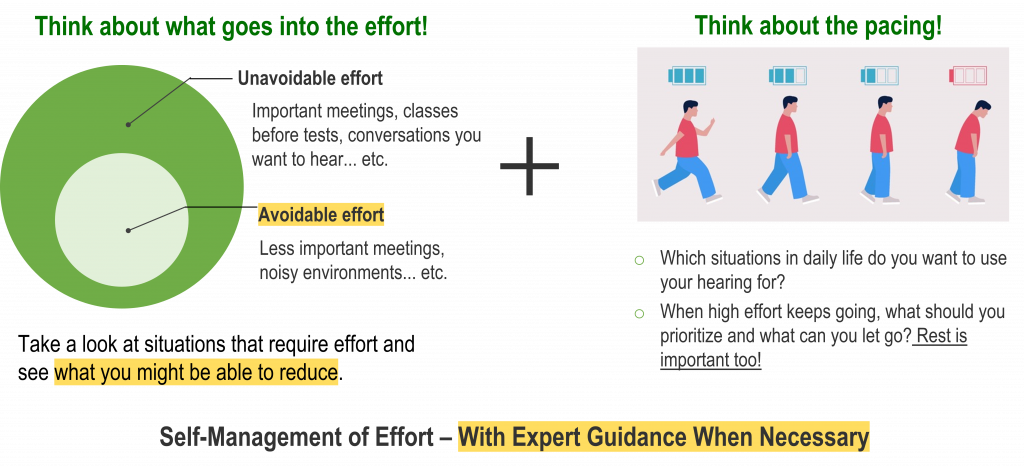
Just like in a marathon, it’s essential to encourage everyone to consider their own pace, deciding ‘where to give their best’ and ‘where to take it a little easier.’ Starting with recognizing individuals’ own effort levels is really helpful, and creating a supportive environment where others understand this can make a big difference in offering the right kind of encouragement. This understanding of individual hearing pace contributes to overall well-being.
References
- Bess, F. H., et al. (2014). How hard can it be to listen? Fatigue in school-age children with hearing loss. Grantee Submission, 20, 1-14.
- Koelewijn, T., et al. (2018). The effect of reward on listening effort as reflected by the pupil dilation response. Hearing Research, 367, 106-112.
- Pichora-Fuller, M. K., et al. (2016). Hearing impairment and cognitive energy: The FUEL framework. Ear and Hearing, 37, 5-27.
- Shields, C., et al. (2023). Exploring the correlations between measures of listening effort in adults and children. Trends in Hearing, 27.
- Tabaru, K. (2023). The perspective of listening effort. Journal of Japanese Educational Audiology Research, 17, 25-33. [Japanese]
- Tabaru, K., Kubo, A., & Shoji, H. (2021). Neurophysiological approaches to listening in noise. Japanese Journal of Clinical Neurophysiology, 49(4), 179-183. [Japanese]
- Zapata-Rodríguez, V., & Santurette, S. (2024). Reducing sustained listening effort and listening stress with Oticon Intent™.